 English
 Nederlands
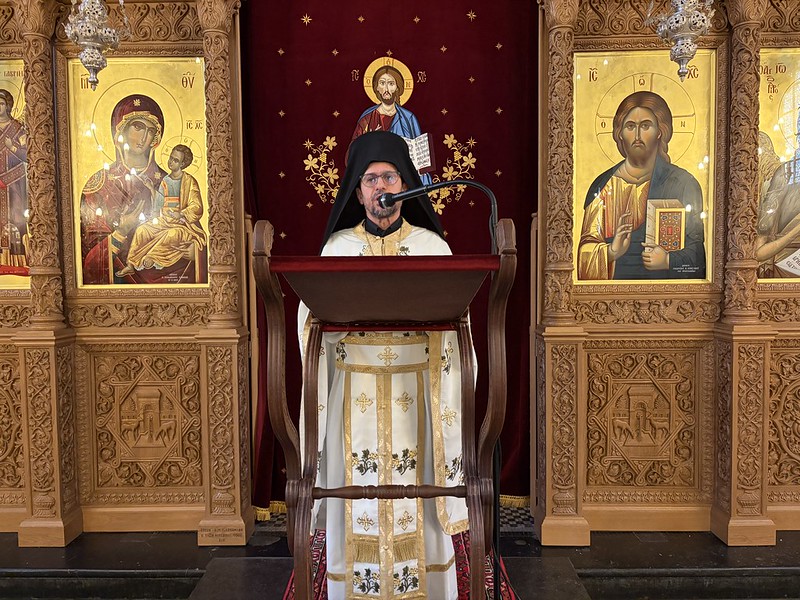
Sermon of father Joan Lena on the Akathist Hymn
In the name of the Father, of the Son and of the Holy Spirit.
Rejoice! Χαῖρε! Rejoice!
This is the continuous refrain of one of the most striking poetic hymns of the Orthodox Church. In the middle of the ascetic struggle of Great Lent, – your Eminence, your Grace, dear fathers, dear brothers and sisters in Christ, – our Church presents to us, as a loving Mother, this hymn of joy, this hymn of exaltation, this hymn of hope, this hymn of Good News, of Evaggelion, of Annunciation. And this was the original liturgical place of the Akathist hymn; it was chanted during the Feast of Annunciation on March 25th. The feast of Annunciation always falls during the Great Lent period and it is closely connected to Pascha and to the period preceding it. That is why the Akathist is found from earlier liturgical sources on the Saturday vigils of the Pannychis, that is the service that would be held in the Great Church of Hagia Sophia Friday evening to Saturday morning, either on the fourth or on the fifth week of Great Lent, depending on the decision of the Patriarch of Constantinople. In a later period, the Akathist hymn took its current fixed position on the Fifth Saturday of Great Lent, on the Saturday of the Akathist, as we celebrate today. Some Orthodox traditions chant one of the four sections of the Akathistos on the first four Fridays of Great Lent, within the service of the Small Compline. The whole hymn is chanted within the Small Compline of the Friday of the Fifth Week of Lent, as we did last night, even though it is supposed to be done in the matins of today.
Each of the four sections of the hymn has three stanzas combined with Salutations to the Theotokos, ending with the refrain “Rejoice, O Bride unwedded!”, and three stanzas without the Salutations and with the refrain “Alleluia.” At the end of every fasting week, because Saturday and Sunday are not part of the Great Lent, we are invited to chant and to celebrate that Good News of the Incarnation, which happened through the historical person of Mary, the Theotokos. The caring Mother, which is the Church, symbolised and represented through the caring Mother of our incarnated God, Mary, offers to us this spiritual encouragement and certainty, that God is with us in our spiritual struggle of the Great Lent period.
The Akathist hymn is also a hymn of victory, a hymn of triumph, a hymn of protection, not only on what we could consider a spiritual dimension, but also of our human existence in history. In the synaxarion of the Church, the Akathist hymn is connected to the great historical event of the siege of Constantinople in 626, and this year we celebrate the 1400 anniversary of the chanting of this hymn for the protection of the City of Constantine. The siege took place during the Patriarchate of Patriarch Sergius, who has been a controversial figure due to his monenergetic and monothelitic tendencies. He would lead the defensive actions of the people of Constantinople against the Persian invasion. Some sources would say that he is the author of the Akathist Hymn, but most probably the hymn has its roots in Saint Romanos the Melodos, in earlier periods. The city was saved and this miracle was dedicated to the Mother of God. With gratitude, clergy and laity, chanted the Akathist in the Church of Blachernae, standing, from where the hymn takes also its name, akathist, without sitting. In the Synaxaria, the Akathistos is not mentioned only in connexion to the siege of Constantinople in 626 by the Persians, the Avars and the Slavs during the reign of Emperor Heraclius, but also in connection to a second siege in 673 by the Arabs during the reign of Constantine Pogonatus, and then a third siege in 717 – 718, during the reign of Leo III, the Isaurian, which culminated with a decisive victory over the Arabs. But what about the hymn itself?
Liturgically speaking, the Akathistos is a Kontakion. The kontakia contained 24 or more stanzas and they were poetical homilies, proclaimed from the pulpit. The Akathist hymn is the only kontakion which escaped later liturgical reforms and preserved all its 24 stanzas. The other kontakia have been reduced to only two stanzas, the current kontakion and oikos, read after the 6th ode of the Matin’s canon. The Akathistos of today is a combination of the old Kontakion and a group of twelve Χαιρετισμοί, or “Salutations”, which are attached to the twelve odd stanzas, numbers 1, 3, 5 and so on. These salutations most probably date back to the time of the Third Ecumenical Council in Ephesus in 431, a Christological council, which tries to defend the reality of the Incarnation. Just like the term Theotokos (God-bearer, or Mother of God), which was at the heart of the christological debates of the 5th century and which is a christological term, that is, it refers to Christ being fully God from the moment of his conception in Mary’s womb, so also the Salutations, just like the rest of the hymn, are christological. They do refer to Christ. They do refer to the Incarnated God the Word.
The first part of the Akathist, stanzas one to twelve, celebrate the story of our Lord Jesus Christ, from the Annunciation to the flight into Egypt. Archangel Gabriel announces to Mary that she will give birth to the Saviour, and seeing her confusion and her disbelief, he assures her of the omnipotence of God. It will be the power of God which will make this possible. Both the Archangel and Mary are astonished at what God is about to do. The hymn takes us through Mary’s visit to Elisabeth and through Joseph’s doubts. It makes us join the shepherds who hear the chant of the angels, it makes us follow the star which led the wise men to praise Jesus, who then went back to preach everywhere the appearance of the Saviour, and then we join the elder Simeon who recognises God in the child Jesus.
The second part of the hymn, stanzas thirteen to twenty-four, provide a theological praising of the Mystery of Incarnation, of God becoming human. Being born of an immaculate Virgin, the Creator reveals a new creation, and we are asked to lift up our hearts in order to understand this mystery, to praise, like the angels, the miracle of God living among humans. This action made all human wisdom be silenced by what happens to Mary, revealing the limitations of human logic. In faith we understand God’s mercy, who sends his only-begotten Son like a shepherd to guide his flock. All men, especially the virgin, praise the incarnation and the Theotokos, even though we are aware that earthly chant is incapable to give due praise to such a miracle. The Virgin Mother is praised as the one bearing the Light, which gave us life, the one who bears Him who takes upon himself the sins of all mortals. She is praised as the tabernacle, as the Temple of God, because she gave birth in human flesh to the Word of God. This is the beauty of this precious homiletic hymn, praising the Incarnation of our Lord, God and Saviour Jesus Christ.
But what about Mary? Is Mary just a passive receiver of God’s action? Is she simply a passive responder to God’s initiative? The hymn starts with Archangel Gabriel being sent to her, in order to bring Mary a great news, to actually tell her to rejoice. And what is this great news? What is this joy that shines? And what is the curse which vanishes? (Χαῖρε, δι’ ἧς ἡ χαρὰ ἐκλάμψει· χαῖρε, δι’ ἧς ἡ ἀρὰἐκλείψει. – Rejoice, through whom joy shall shine forth; Rejoice, through whom the curse shall vanish.)It is the announcement of the fulfilment of the promise of God to Adam and Eve, after their fall, that he would not give up, that he would surpass the natural consequences of sin, ultimately losing joy and meriting a curse, the curse of being away from God. What had been expected in the dramatic history of human existence is now becoming a reality. God here takes the initiative and he moves to that stage of his divine mission to participate in human life, within his own creation, so that we, the humans, can participate in divine life, dragging with us all of creation, which the first humans had dragged away from God. (Χαῖρε, τοῦ πεσόντος Ἀδὰμ ἡ ἀνάκλησις· χαῖρε, τῶν δακρύων τῆς Εὔας ἡ λύτρωσις – Rejoice, fallen Adam’s restoration; Rejoice, redemption of Eve’s tears.)
And the angel is shocked (ἐξίστατο). He’s shocked because he sees the God of eternity taking actually a human existence. He sees God the Logos, the Word, the Wisdom, the one who created everything, to actually become a creature himself and be born from Mary as a little child, so that creation could be renewed (Χαῖρε, δι’ ἧς νεουργεῖται ἡ κτίσις· χαῖρε, δι’ ἧς βρεφουργεῖται ὁ Κτίστης – Rejoice, through whom creation is renewed; Rejoice, through whom the Creator becomes an infant). God’s love for us knows no boundaries. God becomes crazy and does something unthinkable. He becomes vulnerable and weak. He empties himself and becomes one of us. And the angel stands there in amazement. He has no choice but to start to tell Mary exactly what the reason of her joy should be, to tell her exactly what it is happening. And this is what the salutations are revealing to us. The reason for Mary’s joy is exactly the incarnation in her of God, God becoming human in her. Mary needed some explanations, because what was being told to her was a paradox. She was a virgin. How could she have a child? (Βλέπουσα ἡ Ἁγίαἑαυτὴν ἐν ἁγνείᾳ, φησὶ τῷ Γαβριὴλ θαρσαλέως· Τὸ παράδοξόν σου τῆς φωνῆς, δυσπαράδεκτόνμου τῇ ψυχῇ φαίνεται· ἀσπόρου γὰρ συλλήψεως τὴν κύησιν πῶς λέγεις; – The holy one, beholding herself in innocence, says to Gabriel: The incredible tidings of your voice appear difficult for my soul to accept. For how do you speak of childbirth from a seedless conception?) So what is going here? God is waiting for Mary’s answer. Mary has to say “yes”. Mary is free to accept or not. And then she does. She responds with the “Hineni – Here I am!”. Ἰδοὺ ἡ δούλη κυρίου· γένοιτό μοι κατὰ τὸ ῥῆμά σου!
It is exactly this human freedom, it is exactly this human response in Mary, that the Akathist hymn is revealing to us, and it is inviting us to do liturgically, because Mary had a choice. We start with the Archangel coming to her. We start with the Archangel asking her if she really wants to be part of the economy of salvation, of that act that God does, descending from heaven, leaving his throne, and becoming a simple human being so that he can reach us where we are. And it is exactly this the reason that Mary becomes a cooperation, a collaborator, a synergos, somebody that works together with God for the history of her own salvation and of our salvation. God needed Mary in order to incarnate. God needed Mary as a temple in order to abide in her. And he needed her to do this as a free response, because this is an act of love and love demands freedom. He needed her to do this out of free choice. And once he abides in her, Mary becomes this temple, this temple of joy, for which we are saying in every salutation: Rejoice! Χαῖρε! Rejoice!
But what about us? Are we simply spectators of this great event of the Incarnation? Are we simply to contemplate Mary and her decision which would change the course of human history and destiny? Or are we also somehow involved in it? This is the question. And the answer is no! We are not simply spectators, but we are partakers; we are active partakers, we are synergoi. We are partaking and participating through our liturgical experience exactly in all the events that involved Mary. We are joining the angels and everybody else in praising her, but we are also joining Mary in having God, exactly the same God, our own creator, to be incarnated also in us, to be incarnated in us by us becoming children of God, by us becoming gods by adoption. This is not about having a moral relationship with God, this is not about having a legal and trade relationship with God, this is not about having a submissive relationship with God. This is about having the most intimate relationship we could ever have, where we actually eat our own God and Creator, and become like him, be deified (theosis), become a temple of God, where his presence, his shekinah, his parousia, is exactly within us. So, whenever we are saying Χαῖρε to the Theotokos, whenever we are saying “Rejoice!” to Mary, we are actually saying it also to ourselves. This is our good news. Each one of us becomes a temple, a temple in which God is incarnated. And the proof we have is the saints, and the proof we have is the holy ones that surround us time and again. And the proof we have is also our gathering together, ἐπὶ τὸ αυτό, in order to share his body and blood, to participate in his body and blood and to become his body and blood. This is what the joy, the joy of the incarnation does to us. This is the reason for joining the angels, archangel Gabriel and everybody that has said this prayer before us, in proclaiming to Mary the Χαῖρε. Because when we are saying Χαῖρε, we’re announcing exactly the tremendous, paradoxical, crazy movement of God towards us, embracing us, assuming us, not only as persons, but also as human existence with all its static and dynamic dimensions. May the blessing and the intercessions of our mother, of Christ’s mother, the Most-Holy Theotokos, and of all the saints be with us during our journey towards the light of the resurrection, during our journey at the end of which we will acclaim and proclaim that the tomb is empty. We will proclaim Christ’s resurrection. We will proclaim our own resurrection. Amen!