 English
 Français
 Nederlands
 Ελληνικά


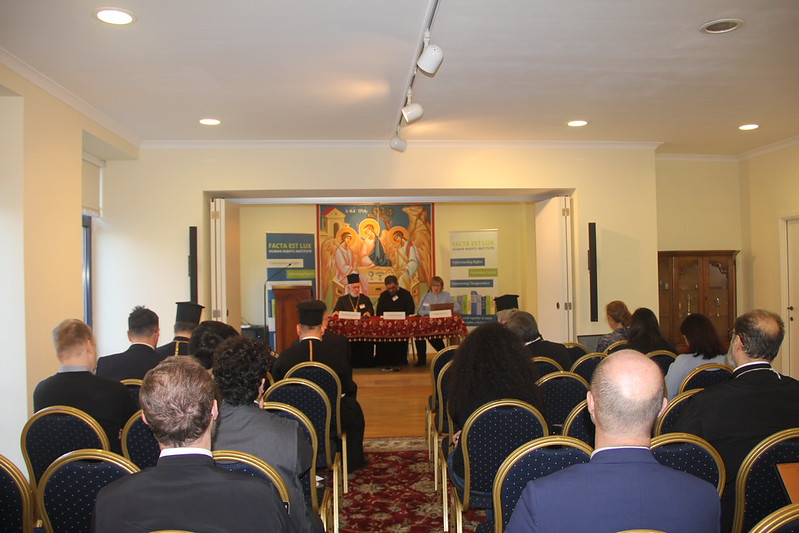
The Values of the Holy Fathers in the Age of Artificial Intelligence: An Orthodox Christian Analysis of the Human Person, Children and the Family Structure
Orthodox Christian anthropology understands the person as embodied and relational, called to communion with God and with others. Families with children increasingly find their domestic space shaped by technologies that collect information and influence everyday choices.
On 19-20 November 2026, an international conference entitled “The Values of the Holy Fathers in the Age of Artificial Intelligence: An Orthodox Christian Analysis of the Human Person, Children and the Family Structure” brought together Orthodox hierarchs, theologians, academics, researchers, legal experts and representatives of Christian institutions, the Belgian Ministry of Defence and the European Commission at the Orthodox Centre Ambiorix in Brussels.
His Eminence Metropolitan Athenagoras of Belgium, Exarch of the Netherlands and Luxembourg of the Ecumenical Patriarchate brought the blessings of His All-Holiness Patriarch Bartholomew and said: “It is of great importance to reflect on contemporary challenges in digital age from the point of view of Holy Fathers in the area of freedom of consciences, employment, medicine, services. Human greed and exploitation of human dignity needs to be eliminated as a threat to all human beings, and the research, science and innovation must serve to protect the humankind”. The starting point of the discussions was the biblical understanding of the human being as created in the image and likeness of God (Genesis 1:26-27). Human dignity is inherent; it is not earned through intellectual ability, productivity or technological competence, nor is it diminished by dependence or vulnerability.
The conference participants discussed the red lines in today’s society—echoing core safeguards under the EU AI Act (such as human oversight and prohibitions against manipulative or exploitative AI practices targeting children and vulnerable persons) and the Digital Services Act (protecting minors online)—and stressed that people and institutions remain accountable for decisions made with AI. Drawing on the wisdom of the Church Fathers, participants also explored how families, educators and churches might discern when to use AI, when to set limits and when to set it aside. A system can simulate a conversation, but some encounters require the presence of another person. A data profile captures only some aspects of a person’s life. How well an AI system performs a task is one consideration. Those deciding whether to use it must also weigh its effects on human freedom and relationships. One contribution on human–robot collaboration asked which decisions should remain with workers when a robot carries out a task autonomously.
Given the speed of technological development, the implementation of the EU digital legal framework particularly the EU Artificial Intelligence Act (Regulation (EU) 2024/1689), the Digital Services Act (Regulation (EU) 2022/2065), and the General Data Protection Regulation (GDPR)—needs to follow the speed of AI innovation. The Church is called neither to reject every technological development nor to accept innovation without discernment. Its responsibility is to help ensure that technology remains at the service of human life, rather than becoming a measure of human worth or an authority over human existence.
The conference was organized under the blessing of His Eminence Metropolitan Athenagoras of Belgium, Exarch of the Netherlands and Luxembourg of the Ecumenical Patriarchate in cooperation with CROCEU, the Orthodox Centre Ambiorix, the Apostle Paul Institute of Orthodox Theology and the Orthodox Theological Institute of Saint-Serge. The conference provided an opportunity for dialogue between theology, science, law and other fields of expertise. It was initiated by Facta est Lux – Human Rights Institute (FEL-HRI) based in Brussels.
PHOTO: https://www.flickr.com/photos/148264890@N07/albums/72177720336986920