English
 Français
 Nederlands
 Ελληνικά
Metropolitan Athenagoras of Belgium became a doctor in Theology
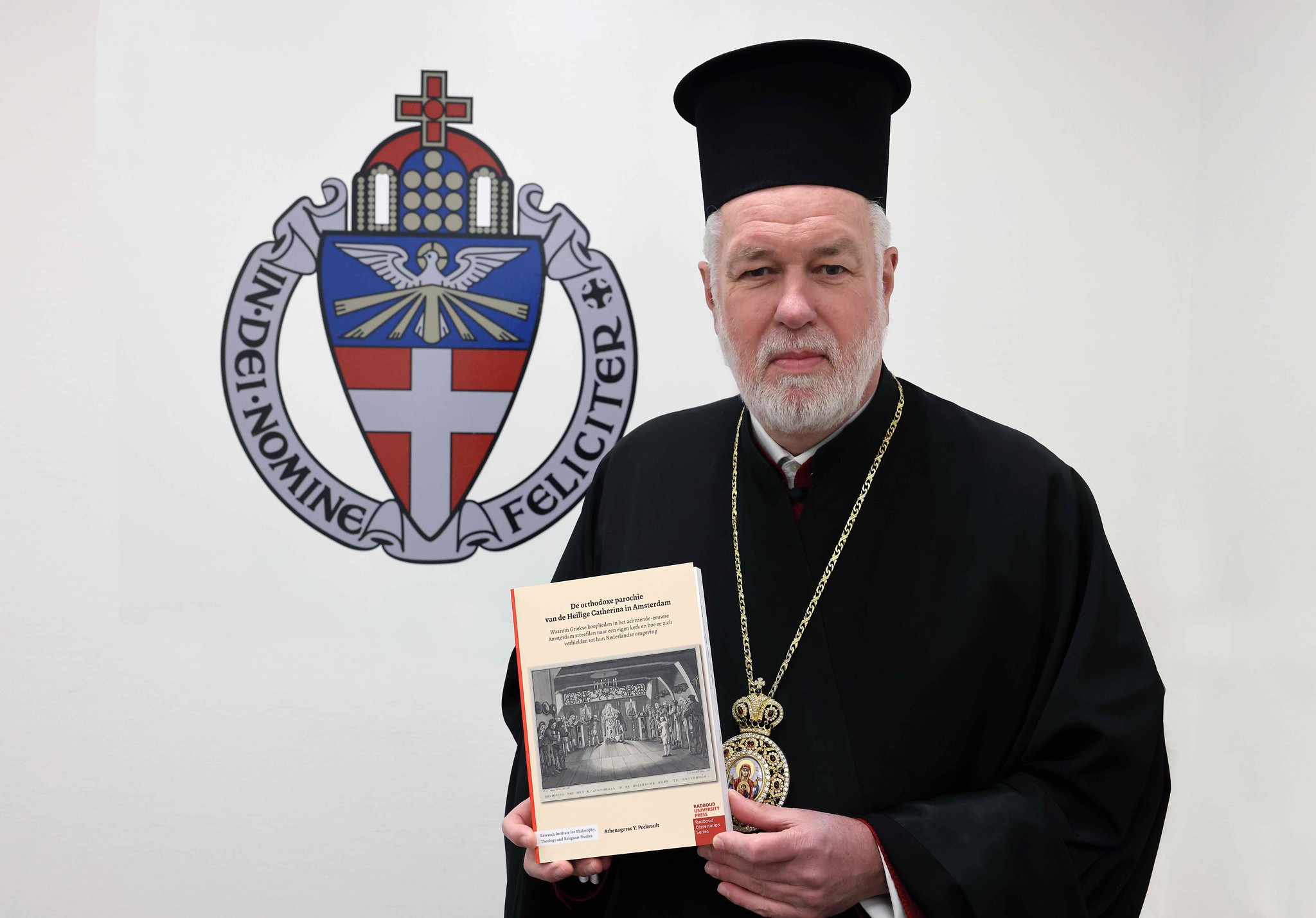
His Eminence Metropolitan Athenagoras of Belgium and Exarch of the Netherlands and Luxembourg (Ecumenical Patriarchate), President of the Orthodox Bishops’ Conference of the Benelux, was awarded the degree of Doctor of Theology by Radboud University Nijmegen on 11 May 2026, following the public defense of his doctoral dissertation entitled: “The Orthodox Parish of Saint Catherine in Amsterdam” (1752–1886).
Metropolitan Athenagoras devoted his research to the foundation, development, and significance of an Orthodox parish in eighteenth-century Amsterdam, established by Greek merchants who had settled in the commercial metropolis. This parish had remained virtually unknown to scholarship. At a time when Orthodox presence in Western and Central Europe was exceptionally rare—with fewer than ten such communities in existence—this parish constituted a remarkable religious and social meeting place for Orthodox migrants, soon including Russian faithful as well.
At the heart of the study are questions concerning why these Greek migrants placed such importance on establishing their own church, how this parish community functioned in a predominantly non-Orthodox environment, and what role religious identity played in the life of this migrant community. For the first time, the dissertation reconstructs the complete history of this largely forgotten community and situates it within the broader context of migration, international trade networks, and the complex relationships between Eastern and Western Christian traditions in the eighteenth century.
In doing so, the study sheds new light on the ways migrant communities shaped and preserved their faith and identity in a new environment. Metropolitan Athenagoras based his research on little-known or previously unknown primary sources discovered in various archives. Among these, he uncovered the Dutch translation of the Divine Liturgy of Saint John Chrysostom dating from 1760.
For his doctoral work, Metropolitan Athenagoras was supervised by Professor Dr Peter Nissen, who sadly passed away in February 2026, and Professor Dr Heleen Murre-van den Berg, both of Radboud University Nijmegen. Peter Nissen was a distinguished Dutch church historian and theologian, renowned for his work in the history of spirituality, religious culture, and the social role of Christianity in Europe. Heleen Murre-van den Berg is an internationally acclaimed professor whose scholarship has made a major contribution to the study of Eastern Christianity and the Middle East, particularly through her research on Syriac Christianity, religious minorities, and the interaction between religion, language, and politics.
Summary of the Dissertation
This thesis focuses on the establishment and development of an Orthodox parish in Amsterdam in the 18th century, founded by Greek merchants in a context marked by migration, religious plurality and the geopolitical tensions of the time. It seeks to understand why and how these merchants, most of whom came from Ottoman territories such as Chios or Smyrna, undertook to establish an autonomous ecclesiastical community in a Protestant city, and to what extent this initiative was part of both an effort to preserve their identity and a process of integration into Dutch society.
The study places this community experience in the broader context of the condition of the Orthodox Church under Ottoman rule, the redefinition of Greek identity in the diaspora, and missionary competition from Western denominations. In this context, the founding of St Catherine’s Church in 1752, Amsterdam’s first Orthodox parish, appears as an essential religious act but also as a cultural and confessional strategy aimed at asserting ecclesiastical independence. Despite the absence of a local episcopal authority, the remoteness of the Ecumenical Patriarchate, and the difficulties inherent in migrant life, the community managed to organize a regular liturgical life and make its church a place of worship, cohesion, and transmission of the faith.
The research highlights the religious, social, cultural and diplomatic dimensions of this parish. It shows how, through collective efforts, the Greeks established links with the Ecumenical Patriarchate and the Church of Russia, even benefiting from the support of Catherine II. It also highlights the dynamics of integration into the local fabric, evident in the participation of Greek merchants in civic life, in mixed marriages, in the learning of Dutch and in the translation of the liturgy of St John Chrysostom into the vernacular, a pioneering undertaking aimed at sharing the Orthodox tradition with the host community. Furthermore, the dissertation analyses the internal tensions between traditionalists and supporters of openness to Enlightenment ideas, while revealing the contacts established with representatives of the Reformed Churches in a climate of ‘pragmatic ecumenism’.
Beyond the history of a small community, the parish of Saint Catherine illustrates the harmonious coexistence between Greeks and Russians in the diaspora and bears witness to the ability of Orthodox Christians to function as an intercultural and interfaith hub in Western Europe. Its gradual decline, caused by the restructuring of trade routes, political upheavals linked in particular to the French Revolution and the emergence of the Greek state, came to a symbolic end with the death of Queen Anna Pavlovna, the only Orthodox sovereign of the Netherlands and the parish’s last protector.
By drawing on a wide range of previously unpublished archival sources and specialized bibliography, this study revisits the history of Greeks in the Netherlands, highlighting the role of religion in community life and shedding light on the interactions between identity, faith and integration. It demonstrates that the creation of a parish in Amsterdam was not simply a religious episode, but rather a laboratory for identity, intercultural and confessional experiments, whose legacy, carried on in particular by figures such as Adamantios Koraïs, contributed both to the Greek national awakening and to the memory of the diaspora.The gradual decline of the parish—caused by shifting trade routes, political upheavals, particularly those linked to the French Revolution, and the emergence of the modern Greek state—found its symbolic conclusion in the death of Queen Anna Pavlovna, the only Orthodox queen in the Netherlands and the final patroness of the parish.
Drawing on a wide range of largely unpublished archival sources and specialised scholarship, this study re-evaluates the history of the Greek presence in the Netherlands. It underscores the role of religion in communal life and illuminates the interaction between identity, faith, and integration.
The dissertation demonstrates that the establishment of a parish in Amsterdam was not merely a religious event, but rather a laboratory for identity formation, intercultural encounter, and confessional experimentation—whose legacy, supported in part by figures such as Adamantios Korais, contributed both to the Greek national awakening and to the collective memory of the diaspora.
Radboud University Nijmegen
Radboud University Nijmegen, founded in 1923 as the Catholic University of Nijmegen, was established out of a desire to provide Roman Catholics with greater opportunities within Dutch society. Named after Saint Radboud, Bishop of Utrecht (899–917), the university has long combined academic excellence with a mission of social emancipation, adopting its current name in 2004.
Today, Radboud University is recognized as a broad, international institution of higher education and ranks among the leading universities in the Netherlands. It enjoys a strong academic reputation, is known for high-quality research, and is distinguished by its attractive green campus.
Although the university officially lost the designation “Catholic” in 2020 through a decision of the Dutch bishops, Rome judged that Radboud University continues to maintain its Catholic identity. Its theological faculty remains rooted in the Christian tradition and lived faith experience.
The Faculty of Philosophy, Theology and Religious Studies is widely respected for its rigorous scholarship, critical engagement, and strong historical orientation. It combines in-depth research and teaching with an active contribution to public debate and contemporary societal questions.
Biography of Metropolitan Athenagoras
His Eminence Metropolitan Athenagoras of Belgium was born in Ghent, the son of Ignace Peckstadt (lawyer and archpriest of the Orthodox parish of Ghent) and Marie-Thérèse Janssens.
After some years of studying law at Ghent University, he pursued theological studies at the Aristotle University of Thessaloniki, from which he graduated summa cum laude. He subsequently undertook postgraduate studies at the Ecumenical Institute of Bossey (University of Geneva).
In 1989, he was ordained deacon in Brussels by Metropolitan Bartholomew of Philadelphia (now the Ecumenical Patriarch), who entrusted him with the name Athenagoras in memory of the great Ecumenical Patriarch Athenagoras. He served as Archdeacon of the Orthodox Metropolis of Belgium until his priestly ordination in 1996. He was appointed Episcopal Vicar for the Western-language parishes of the Metropolis (Benelux). From 1993 to 1998, he taught Orthodox religious education in several Flemish secondary schools. Between 1994 and 2015, he produced an orthodox program on the Belgian public Radio and Television, both in Flemish and in French. In 1994, the Holy Synod of the Ecumenical Patriarchate appointed him as collaborator of the then newly established Liaison Office of the Orthodox Church to the European Union. In 1995, he founded a new parish in Bruges, where he served as rector. He later founded additional parishes in Ostend (2001) and Hasselt (2008). For many years, he has also served as Orthodox chaplain to Brussels Airport. Following his unanimous election by the Holy Synod of the Ecumenical Patriarchate as auxiliary bishop to the Metropolitan of Belgium, with the distinguished title Bishop of Sinope, he was consecrated bishop on 22 June 2003 in the Orthodox Cathedral of Brussels. On 27 November 2013, the Holy Synod of the Ecumenical Patriarchate unanimously elected him Metropolitan of Belgium and Exarch of the Netherlands and Luxembourg. His enthronement took place on 21 December 2013. He chairs numerous commissions and currently serves as President of the Orthodox Bishops’ Conference of the Benelux, as well as Co-Chair of the Dialogue with the Anglican Church. He has frequently represented the Ecumenical Patriarchate in official missions, inter-Orthodox gatherings, and inter-Christian conferences, and has accompanied the present Ecumenical Patriarch Bartholomew on several important international journeys.